4 min
4 min 
Google’s review algorithm decides which reviews rise to the top and which barely get noticed.
In simple terms, it’s designed to highlight reviews that are detailed, trustworthy, and useful so people can make smarter buying decisions.
When you understand how it works, you can guide customers to leave reviews that help your business establish a strong online reputation.
How the Google review system works
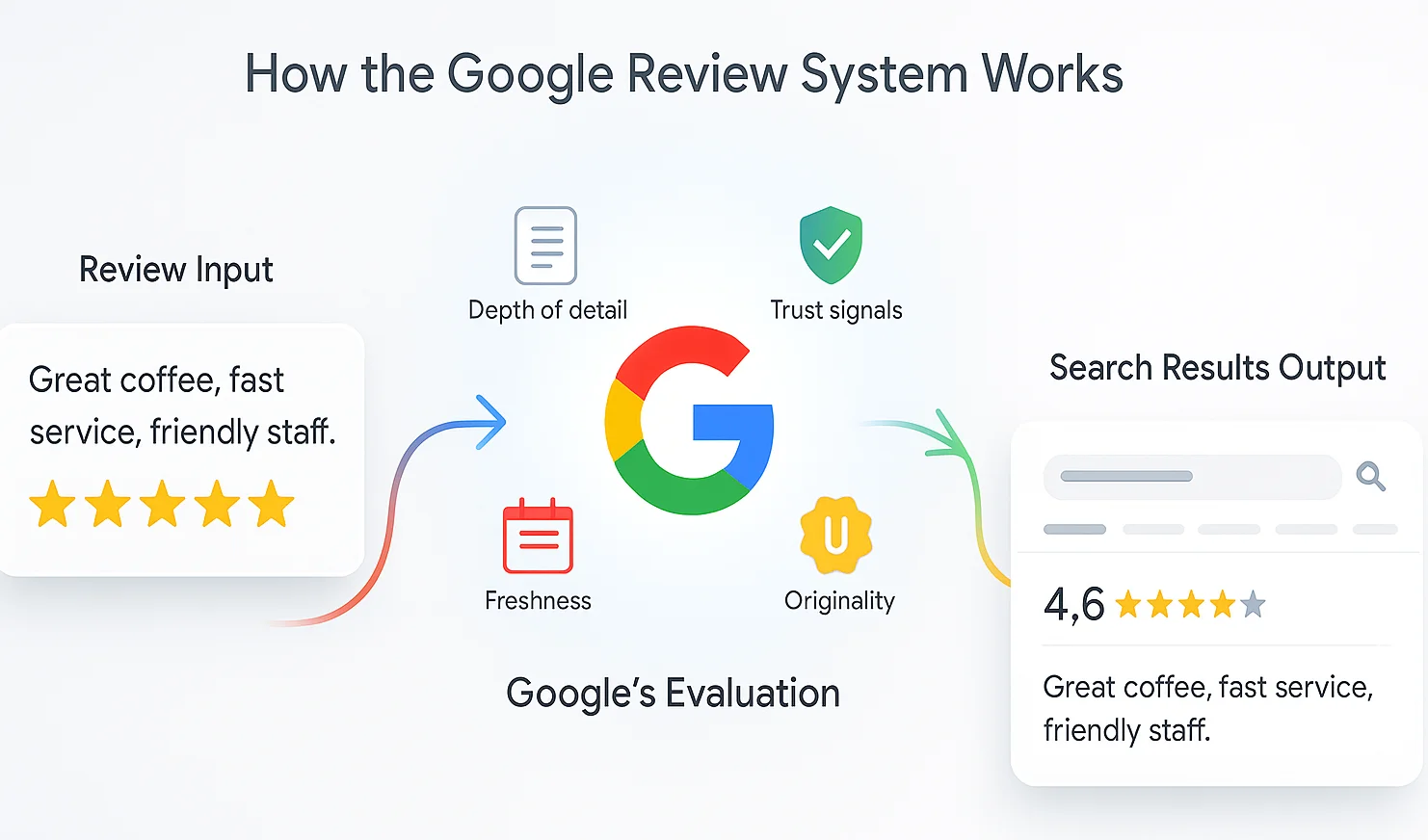
Google’s goal is simple: help people make informed decisions. The review system is built to surface helpful, reliable, and original feedback.
That’s why a five-paragraph review from someone who actually bought the product has more impact than ten vague “It’s great!” comments.
Think of it this way: Google wants reviews to serve as mini buying guides. The algorithm filters out noise, ensuring that only the most valuable insights remain, making the system fair for all.
What type of content is evaluated
The system pulls from multiple sources, including:
- Google Business Profiles (restaurants, salons, mechanics)
- Google Shopping and product listings
- Third-party review sites (sometimes aggregated into search results)
This means that whether you run a local café or sell gadgets online, your reviews can significantly influence your search visibility.
What reviews can cover?
Google doesn’t limit reviews to “good” or “bad.” The most valuable reviews explain:
- Product features: durability, size accuracy, design
- Customer experience: staff friendliness, delivery times, support
- Comparisons: “I switched from Brand A, and here’s what’s better/worse”
The broader the detail, the more it helps future customers. Reviews that read like personal stories often rank higher because they signal authenticity.

All your Google reviews in one place
Collect Google reviews, manage every response, and display them where they matter most.
Start Free →How reviews are evaluated
Google looks at several factors when deciding which reviews matter most:
- Expertise & experience: Does the reviewer demonstrate that they have actually used the product/service?
- Depth of detail: Longer isn’t always better, but substance counts. A review that highlights both pros and cons often gets more weight.
- Originality: Copy-pasted or duplicate reviews lose credibility.
- Trust signals, such as verified purchases, attached photos, or a consistent reviewer history, add legitimacy.
- Freshness: A detailed review from last week often outweighs one from two years ago.
Low-value reviews, such as single-word responses or spam, are pushed down or ignored.
Languages covered
Google’s system works worldwide. Reviews in local languages usually rank well for local searches.
For example, a French review about a Paris café will likely be prioritized for French users searching nearby.
English often processes fastest, but relevance always comes first.
Role of structured data
Structured data (schema markup) helps Google connect reviews with specific products or services. When used correctly, it can:
- Trigger star ratings directly in search results
- Display review snippets under your listing
- Improve how Google understands the context of reviews
Example: If your product page includes schema markup for reviews, Google may display a 4.6-star rating in search results.
That extra visibility can double click-through rates.
Show real Google reviews that build trust
Collect and display photo, video, and text reviews with full design control.
Start Free →3 Tips for businesses to make Google reviews more effective

Here’s how you can guide customers and use reviews to strengthen your online presence.
1. Encourage detailed and specific reviews
Generic reviews don’t help much. Instead, prompt customers to be specific:
- “What did you like most about the product/service?”
- “How did it compare to your expectations?”
- “Would you recommend it, and why?”
Example: “The shoes fit true to size and lasted through a 10-mile hike” is infinitely more potent than “Love them.”
2. Focus on recency and consistency
Google values a steady flow of feedback over time. Ten reviews from launch week won’t carry you forever. Create a process for ongoing review requests:
- Send a follow-up email post-purchase.
- Add a slight nudge in receipts or packaging.
- Ask after successful service interactions.
Fresh reviews show Google (and customers) that your business is active and trustworthy at the moment.
3. Respond to reviews and add engagement
Engagement matters. Replying to reviews tells both customers and Google that you’re present.
- Thank customers for positive reviews.
- Address negative reviews with empathy and solutions.
- Add context where needed (e.g., “We’ve since improved our shipping process”).
Pro tip: Even a simple “Thanks for sharing!” can strengthen trust signals.
Wrap up
Google’s review algorithm isn’t about tricking the system. It rewards quality over quantity, detail over vagueness, and authenticity over fluff.
If you’re a business owner, the best move is to encourage genuine, helpful feedback from real customers and stay engaged with it.
That’s what builds credibility with both search engines and people.
✅ Next step: Audit your last 20 Google reviews. Are they detailed? Recent? Balanced? Use that as your baseline to plan smarter review requests going forward.
Frequently asked questions
No. A handful of detailed reviews often outweighs dozens of vague “good service” comments.
Fresh reviews can influence visibility within days, but consistency over months has the strongest effect.
No. Google only removes reviews that break its policies, like spam or fake content.
Yes. Extra proof like images or purchase verification gives the review more trust signals.
Yes. Reviews written in the local language usually rank higher for local searches.

Krunal